An arm hanging loose, a screw gone missing or a lens lying on the table: broken glasses always seem to happen when you need them most. The table below shows you in a minute which repairs you can do yourself, which belong with an optician and who pays if your glasses broke in a fall.
In short
- You can often fix a loose screw, a slightly bent metal arm or a lens that has popped out of a full-rim frame yourself.
- Broken arms, bridges and spring hinges, bending acetate and varifocal lenses are a job for an optician.
- Never glue your glasses and never heat acetate with a hairdryer or hot water: both can ruin the frame for good.
- If someone else damaged your glasses, ask whether their insurance will cover it. Your own accidents are only covered if your policy includes them.
Broken glasses: what can you fix yourself?
You can fix anything that only needs a mini screwdriver and a steady hand: loose or missing screws, slightly bent metal arms, a lens that has popped out of a full-rim frame and push-on nose pads. As soon as something has snapped, acetate needs bending or varifocals are involved, take your glasses to an optician.
| Damage | DIY? | What to do |
|---|---|---|
| Loose screw | Yes | Tighten with a mini screwdriver, don’t overtighten |
| Missing screw | Temporarily | Spare screw from a repair kit or a toothpick, then see an optician |
| Bent arm | Metal yes, acetate no | Straighten metal in small steps, have acetate warmed by an optician |
| Broken arm or bridge | No | Optician: soldering, spare part or a new frame |
| Lens popped out | Often, with full-rim frames | Pop it back in; varifocal, rimless and semi-rimless to an optician |
| Scratched or cracked lens | No | New lenses from an optician, scratches can’t be polished out |
| Lost nose pad | Yes, with push-on or click-on pads | Press on or screw on a matching spare pad |
| Broken spring hinge | No | Optician: new hinge, or a spare arm if one is available |
What you need: a glasses repair kit with a mini screwdriver and spare screws, tweezers and a soft cloth. The most common problem is also the easiest to fix: a loose screw.
How do you tighten a loose screw on your glasses?
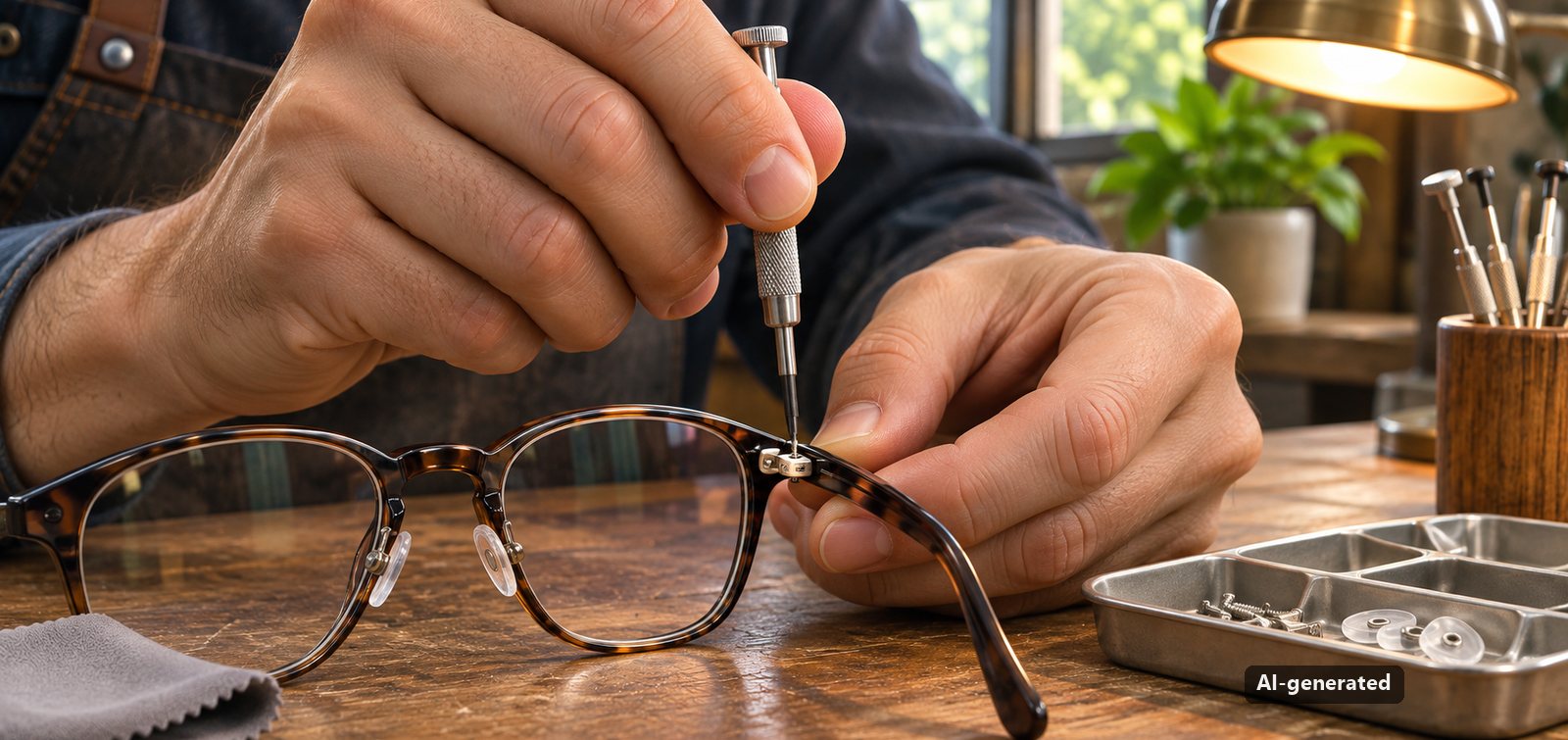
Open the arm and lay your glasses on a soft cloth. Fit a mini screwdriver squarely into the screw head and turn clockwise until you feel resistance. Then stop: turning further strips the fine thread or snaps the screw head. The arm should still open and close smoothly afterwards.
Lost the screw? How to fit a new one
- Search on a light-coloured surface, as glasses screws are only a few millimetres long.
- Line up the hinge parts so the holes sit exactly on top of each other.
- Insert the spare screw with tweezers and tighten it gently.
- Open and close the arm a few times: it should move evenly.
No spare screw to hand? A wooden toothpick pushed through the hinge and snapped off at both ends will hold the arm for a few days. After that, an optician can fit a screw that matches.
The screw keeps coming loose
The thread is probably worn or the screw isn’t quite the right size. An optician can fit a new one and secure it with thread lock. Nail varnish is no substitute, as its solvents can attack acetate and lens coatings.
Spring hinge no longer springs back
If only the screw is loose, pull the arm gently outwards until the holes line up, then tighten it. If the arm pops out or the spring has broken, it needs an optician.
Lens popped out of your glasses? How to put it back in
With full-rim frames you can often do it yourself: the lens sits in a groove in the frame and goes back in with gentle pressure. On metal frames a tiny screw holds the rim together, so tighten it afterwards. If the lens only goes in with force, stop, because cold plastic can crack.
- Check the side: the curved side faces forwards, and the shape tells you whether the lens belongs on the left or right.
- Hook in the top: place the outer top corner in the groove, then slide the top edge along to the middle.
- Press in the bottom: push the lower corner gently into the frame with your thumb. On metal frames, then carefully tighten the rim screw.
Hands off varifocal lenses and lenses for astigmatism, which only work in exactly the right position, rimless glasses and semi-rimless frames with a snapped nylon cord. If your vision is less sharp than before, have an optician check your glasses.
Bent glasses: what should you do?
Lay your glasses upside down with the arms open: if both arm tips don’t touch the table, an arm is bent. Metal frames and acetate arms with a metal core can be bent back in small steps. Leave pure acetate, titanium, rimless frames and varifocals to an optician, because they snap, spring back or shift the viewing zones.
- Hold it where you bend: grip the frame right next to the bend so no force goes into the hinge or the lens.
- Small steps: bend, try on, check. Stop at once if you feel resistance or hear a crack.
- No hairdryer, no hot water: acetate warms unevenly and warps, and lens coatings can crack.
Still slipping afterwards? You’ll find the usual causes in our guide to glasses slipping down your nose. But what if the arm isn’t bent but broken?
Can you glue broken glasses?
No, glue won’t repair glasses. Superglue rarely holds for long on an arm, bridge or hinge, because those parts take strain every time you put your glasses on or take them off. It can damage lenses and coatings, and glue residue makes later soldering or fitting a spare part harder. Lenses shouldn’t be glued in either.
A specialist workshop can often solder or laser-weld broken metal, while titanium needs special techniques. A broken acetate front can rarely be repaired for good, but spare arms are available for some models.
When should you take your glasses for repair?
Take your glasses to an optician for repair as soon as something has snapped, a lens has cracked or you see less clearly after a DIY fix. Varifocals, rimless frames and any acetate that needs bending also belong in professional hands. Small jobs such as replacing a screw or swapping nose pads often take just a few minutes.
Who pays for broken glasses after a fall?
That depends on who caused the damage. If you dropped your glasses yourself, you will usually pay for the repair, unless your insurance policy explicitly covers that kind of accident. If someone else broke them, ask whether their insurance will pay. Either way, check the policy wording before you have the repair done.
- Damage caused by someone else: ask the person responsible whether their liability cover pays for the damage. Liability cover only pays for damage the policyholder causes to other people, not for their own belongings.
- Your own accident: whether your home contents insurance pays depends on your policy, for example whether it includes accidental damage cover and covers belongings away from home. Check your policy schedule.
This is general information, not legal advice. In each individual case, the insurer decides.
How can you get replacement glasses quickly?
The fastest fix is a pair you already own: older glasses with a similar prescription, or prescription sunglasses for outdoors. If you don’t have a spare, it’s worth ordering a second pair before the next screw goes missing. With your prescription and pupillary distance, you can do that online, even while your main pair is being repaired.
For everyday wear, lightweight, sturdy titanium frames are a good choice.
 Oakley WINGFOLD EVR (OX5118 511803)£100.54Oakley WINGFOLD EVR (OX5118 511801)£102.64Oakley WINGFOLD EVR (OX5118 511804)£98.45Oakley WIRE TAP 2.0 RX (OX5152 515201)£129.35Ray-Ban RX8725 1028£90.78Oakley WIRE TAP 2.0 RX (OX5152 515203)£124.17
Prices include VAT. Free standard delivery within the UK. Express delivery and other countries: shipping costs.
All titanium glasses →Frequently asked questions about glasses repair
How much does it cost to have glasses repaired?
It depends on the damage. Many opticians tighten screws or swap nose pads quickly, while soldering and spare parts cost more. Ask for a price first and, if the front is broken, compare it with a new pair.
Can you repair a scratched lens?
No. Scratches can’t be polished out of coated lenses, and toothpaste or polishing paste can damage the anti-reflective coating. If the scratches affect your vision, you need new lenses. To keep it from getting that far: how to clean your glasses.
Broken sunglasses: does all this apply too?
Yes, you fix screws, arms and pads the same way. Polarised and prescription lenses must sit in exactly the right position, so if in doubt, let an optician refit them.
Beyond saving? You’ll find titanium frames and prescription sunglasses as a spare above.