Helmet on, and the padding is already pressing your glasses into your temples. Or the frame slides sideways as you pull the helmet down, and you end up fiddling with it in gloves. With the right order, a few helmet features and a flat frame, a motorcycle helmet with glasses works perfectly well, and the same goes for cycle and ski helmets.
In short
- It pinches because the pads press the arms of your glasses against your head. Thick arms that curve down early are the worst.
- With a full-face helmet, put the helmet on first, then slide your glasses in through the visor opening.
- Look for recesses for glasses arms in the padding, a wide visor opening and an anti-fog insert.
- Flat frames with thin, straight arms, for example in titanium, fit best under any helmet.
Why do your glasses pinch under a helmet?
Your glasses pinch because the helmet padding presses the arms against your head. A helmet has to fit snugly so it doesn’t move. For glasses wearers, that pressure is concentrated on a narrow, hard line at the temple and above the ear. The thicker and more curved the arm, the more you feel it.
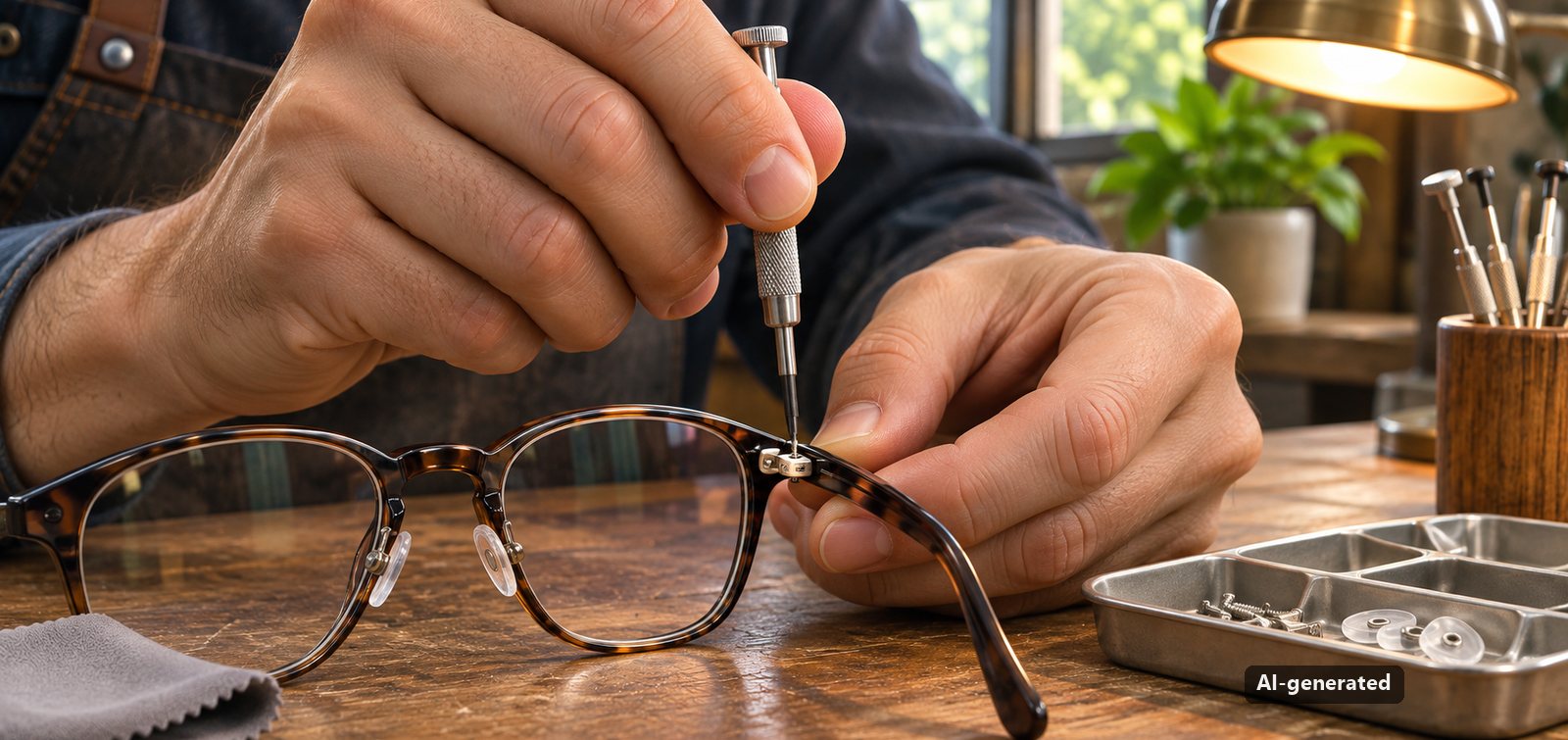
Then there’s the ear bend. If the arm curves down early, it catches on the padding as you slide it in, and the frame ends up crooked. Straight arms glide in smoothly.
So how you put your glasses on matters almost as much as the helmet itself.
Helmet first or glasses first?
With a full-face helmet, put the helmet on first and slide your glasses in afterwards. Otherwise the helmet drags the frame off your nose. With a flip-up helmet, raise the chin bar and put your glasses on as normal. With a visored ski helmet your glasses go first; with a cycle helmet the order doesn’t matter.
- Put the helmet on, fasten the strap and open the visor fully.
- Hold your glasses level and guide the arms through the visor opening with both hands.
- Slide the arms back along the padding or into the recesses until they rest on your ears.
- Check the fit: the frame sits straight on your nose and nothing tugs at your temples.
- To take it off, remove your glasses first, then the helmet.
Full-face, flip-up or open-face: which motorcycle helmet suits glasses?
Any helmet style works with glasses if the padding leaves room for the arms. A flip-up (modular) helmet is the most convenient, because you put your glasses on with the chin bar raised. A full-face helmet fits most snugly, so it needs recesses for the arms. An open-face helmet gives you the most room, but also the most wind.
- Glasses channels: Some helmets have recesses for glasses arms in the cheek or temple pads. Look for terms such as glasses channels or spectacle-friendly in the product description.
- Interchangeable pads: If the cheek pads come in several thicknesses, you can fine-tune the fit around the arms.
- Wide visor opening: Taller frames need space. If the opening is tight, the rim knocks against it.
- Drop-down sun visor: It flips down inside the helmet, so your everyday glasses are enough even when the sun is low.
Always try a helmet on with your glasses, ideally for a quarter of an hour. Pressure you barely notice after five minutes becomes obvious on a long ride.
What stops your visor and glasses fogging up?
The most effective fix for a misted visor is an anti-fog insert. It fits inside the visor and creates a double layer with an insulating air gap. Add a breath guard on the chin bar, which directs your breath downwards, and a visor that opens by a crack. Your glasses themselves can still mist up now and then.
Fogging is worst when you stop, because there’s no airflow to cool things down. Crack the visor open as soon as you pull up at the lights. For the lenses, anti-fog wipes and sprays are an option. → How to stop glasses steaming up
Cycle helmet with a visor or prescription sports glasses?
Both work. A cycle helmet with a visor leaves room for your everyday glasses behind it and keeps off wind, rain and insects. Prescription sports glasses sit closer to your face and replace your normal pair on the bike altogether. For commuting, a visor is often more practical; for longer or faster rides, sports glasses usually make more sense.
Visor helmet: When you try one on, check that your glasses fit behind the visor. Tall frames often touch it at the top. A visor that flips up helps against fogging at junctions.
Prescription sports glasses: Many sports frames can be glazed with your prescription; others use a clip-in insert behind the lens. Wear the arms over the helmet straps so you can take your glasses off without undoing the helmet.
One detail people often miss: on some helmets, the adjustment dial at the back sits exactly where the ends of your glasses arms rest. Then it’s the dial that presses, not the padding.
Ski helmet with visor or OTG goggles: what works with glasses?
The simplest option is a ski helmet with a visor. The visor drops down in front of your normal glasses, so you don’t need goggles at all. The alternative is OTG goggles (over the glasses), which have cut-outs so they fit over your frame. With contact lenses or goggles with a prescription insert, any ski helmet will do.
With a visor helmet, put your glasses on first, then the helmet, and lower the visor. When trying it on, make sure there’s a little space between visor and lenses, otherwise the visor pushes your glasses down your nose. → How to choose ski goggles
Which glasses fit best under a helmet?
Flat, lightweight glasses with thin, straight arms fit best under any helmet. Titanium works particularly well because it is light and strong, so even slim arms keep their shape. The frame shouldn’t be too tall, so it slips through the visor opening. Wide decorative arms and chunky acetate frames cause the most trouble under a helmet.
- Thin, flat arms: They add hardly any bulk under the padding.
- Straight arms: They slide into the padding without catching. An optician can flatten the ear bend.
- Flat frame: It sits close to your face and fits behind a visor or goggles.
- Sports strap: On the bike and on the slopes it keeps your glasses in place. Under a motorcycle helmet it tends to bunch up at the back.
| Helmet | What to look for | Glasses that fit |
|---|---|---|
| Full-face | glasses channels, wide visor opening, anti-fog insert | flat frame, thin straight arms |
| Flip-up | chin bar you can open with one hand | almost any frame with slim arms |
| Open-face | visor or sun visor against the wind | glasses or prescription sunglasses |
| Cycle helmet | adjustment dial, room for the arm ends | prescription sports glasses, sports strap |
| Cycle or ski helmet with visor | enough space between visor and glasses | flat frame that isn’t too tall |
| Ski helmet with OTG goggles | cut-outs for the arms | narrow frame, thin arms |
 Oakley WINGFOLD EVR (OX5118 511803)£100.54Oakley EYEJACKET REDUX (OO9438 943805)£120.03 POakley WINGFOLD EVR (OX5118 511801)£102.64Oakley RADAR EV PATH (OO9208 920847)£113.78Oakley WINGFOLD EVR (OX5118 511804)£98.45Oakley TERRAFORMA (OO9530 953001)£75.81
Prices include VAT. Free standard delivery within the UK. Express delivery and other countries: shipping costs.
All titanium glasses →If your glasses grip too tightly or the arms bend down too early, ask an optician to adjust them. A few minutes with the pliers often decides whether a long ride is comfortable.
Do you have to wear your glasses on a motorbike?
Yes, if you need them to meet the eyesight standard. Rule 92 of the Highway Code, which applies to drivers and motorcyclists, says you must be able to read a number plate in good daylight from 20 metres. If you need glasses or contact lenses to do that, you must wear them at all times while riding.
Your licence may also show code 01, which stands for eyesight correction such as glasses or contact lenses. Think about the ride home, too: under Rule 94, you should not use tinted glasses, lenses or visors at night or in poor visibility if they restrict your vision. In each case, your licence and the official eyesight rules decide; the DVLA can advise.
Frequently asked questions: motorcycle helmet with glasses
Are there motorcycle helmets made for glasses wearers?
There isn’t a separate helmet category. Many helmets do have recesses for glasses arms in the padding, often called glasses channels. Look for those and a wide visor opening.
Can I wear sunglasses under a motorcycle helmet?
Yes, as long as they’re flat enough and, if you need it, have your prescription. A helmet with a drop-down sun visor is often more comfortable: you wear your normal glasses and lower the visor only when the sun is out.
Are contact lenses the better option under a helmet?
With contact lenses there are no arms in the way and no lenses to mist up behind the visor. Whether lenses suit you is something to discuss with your optician or an eye specialist.
Helmet sorted? Then turn to your glasses: the flat titanium frames and sports glasses above are a good place to start.