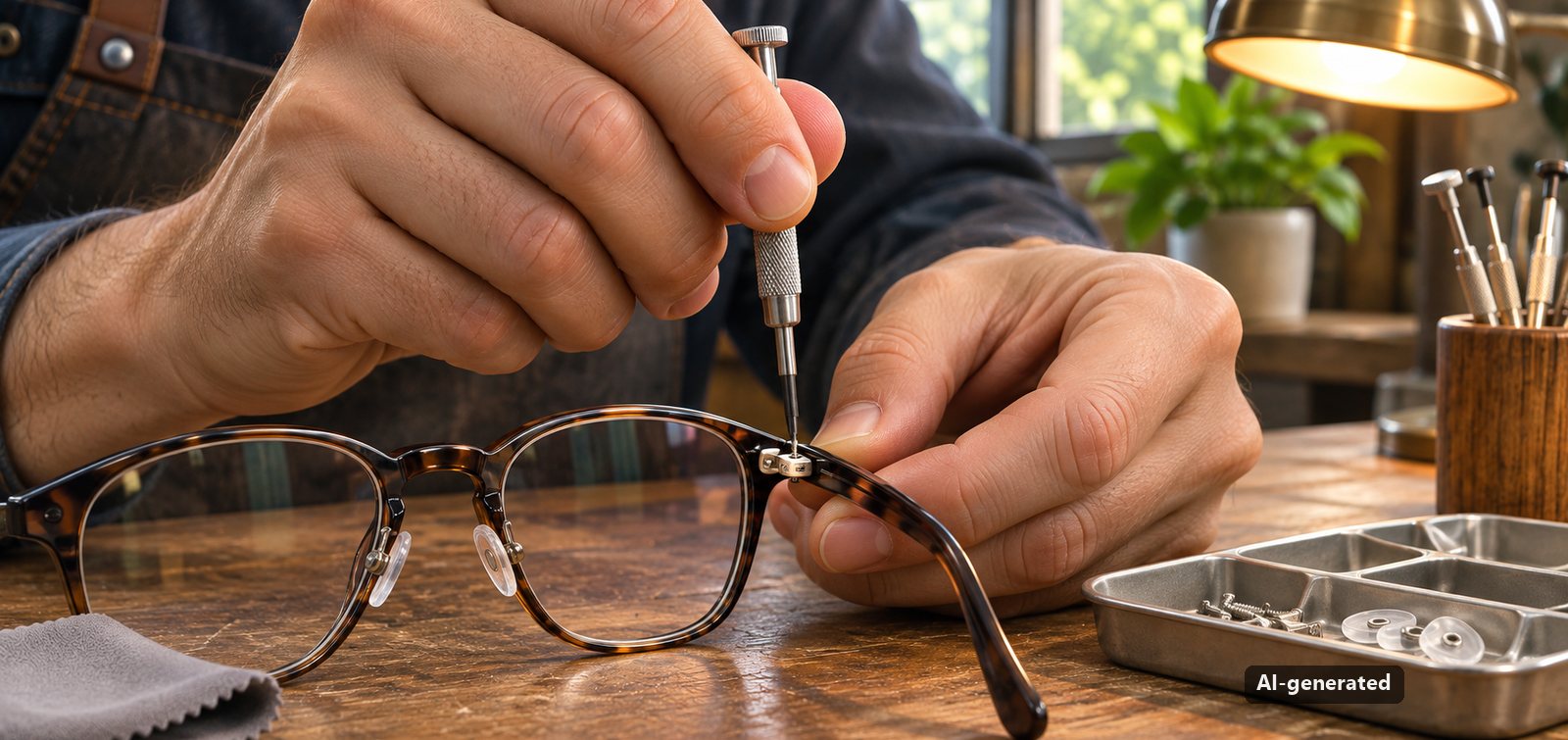
Glasses left on the dashboard, dropped on the sofa or pushed up into your hair: that’s exactly where they pick up scratches, heat damage and bent arms. With the right case and a few simple habits, here’s how to store glasses so the lenses, coatings and frame stay in shape for longer.
In short
- When you’re not wearing your glasses, put them in a case, ideally a hard one. Lens makers ZEISS, HOYA and Rodenstock all recommend this.
- Don’t leave them in the car in summer. According to ZEISS, a car in strong sun can quickly heat up to over 40 °C, and the dashboard to over 80 °C.
- No case to hand? Fold them and rest them on the arms, never on the lenses.
- Don’t push them up onto your head. HOYA says this can knock the frame out of alignment.
What’s the best way to store glasses?
In a hard case, every time you take them off. Rodenstock names a sturdy glasses case as the best option for storage, and ZEISS and HOYA also recommend a hard case. If you don’t have one with you, fold your glasses and rest them on the arms, lenses facing up, away from sunlight and radiators.
Never put your glasses down on the front of the lenses. Rodenstock advises against it, and HOYA says it can damage the coating and cause scratches. According to ZEISS, scratches like these can’t be polished out of plastic lenses.
Which glasses case suits you?
That depends on where your glasses end up when you’re not wearing them. A hard case gives the best protection against pressure and knocks, while a slim soft pouch mainly guards against scratches. For reading glasses that come on and off all day, a glasses cord is a handy alternative to a case.
| Type | Protection | Space | Best for |
|---|---|---|---|
| Hard case | High: against pressure, knocks and scratches | Takes up the most room | Everyday use, travel, sport, children, a spare pair |
| Flip case (slim, with a magnetic or snap lid) | Medium: against scratches and light pressure | Slim, fits a coat pocket or handbag | Out and about, if you take your glasses off often |
| Soft pouch (fabric or microfibre) | Low: against scratches and dust, little against pressure | Very slim and light | Short trips, sunglasses in a handbag |
| Glasses cord or chain | No impact protection, but your glasses can’t fall or get left lying around | Worn on you, no space needed | Reading glasses you take off often |
Keep a microfibre cloth in the case so it’s always there when you need it. Wash it regularly so dirt doesn’t build up in it. A case can’t protect against everything, though, and heat is the big one.
Can you leave glasses in a hot car?
Ideally not in summer. According to ZEISS, a car in strong sunlight can quickly heat up to over 40 °C and the dashboard to over 80 °C, and heat can damage both the lens coating and the frame. Rodenstock states that lenses aren’t designed for extreme conditions such as a car parked in the sun.
ZEISS says plastic lenses are particularly sensitive, as heat can affect how long the coating lasts. Big temperature swings can cause fine surface cracks, because the lens and the coating are built differently. HOYA adds warped frames and loosened lenses to the list.
A case won’t keep the heat out either: ZEISS advises against leaving the case or the glasses on the dashboard for long periods. The same goes for sunglasses. In the car:
- Take your glasses and sunglasses with you when you get out.
- If you take them off while driving, put them in the case, not on the dashboard.
- Don’t keep a spare pair in the car over the summer, not even in the glovebox.
Why not on your head, on the lenses or in your pocket?
Because each of these puts strain on the frame or the lenses. On your head the frame gets stretched, lenses laid face down pick up scratches, and in a trouser pocket your leg, the fabric and your keys press on the arms and lenses. Here’s what happens in each case, and what to do instead.
- On your head: Whether it’s reading glasses on top of your head or sunglasses in your hair, HOYA advises against it. The frame can be pushed out of alignment, so the lenses no longer sit properly in front of your eyes. A stretched frame often slips, as our guide Glasses slipping down your nose explains.
- Face down: Fold your glasses and rest them on the arms, as ZEISS recommends.
- In a trouser or coat pocket: Without a case, keys and coins rub against the lenses, and the arms bend when you sit down. If they go in a pocket, use a case.
- On a chair or the sofa: ZEISS calls this a particularly bad spot, because it’s far too easy to sit on them.
- On a radiator: According to ZEISS, glasses have no business there either.
- In the bathroom next to hairspray and perfume: HOYA says products like these can damage lenses and coatings.
Where should your glasses go at night?
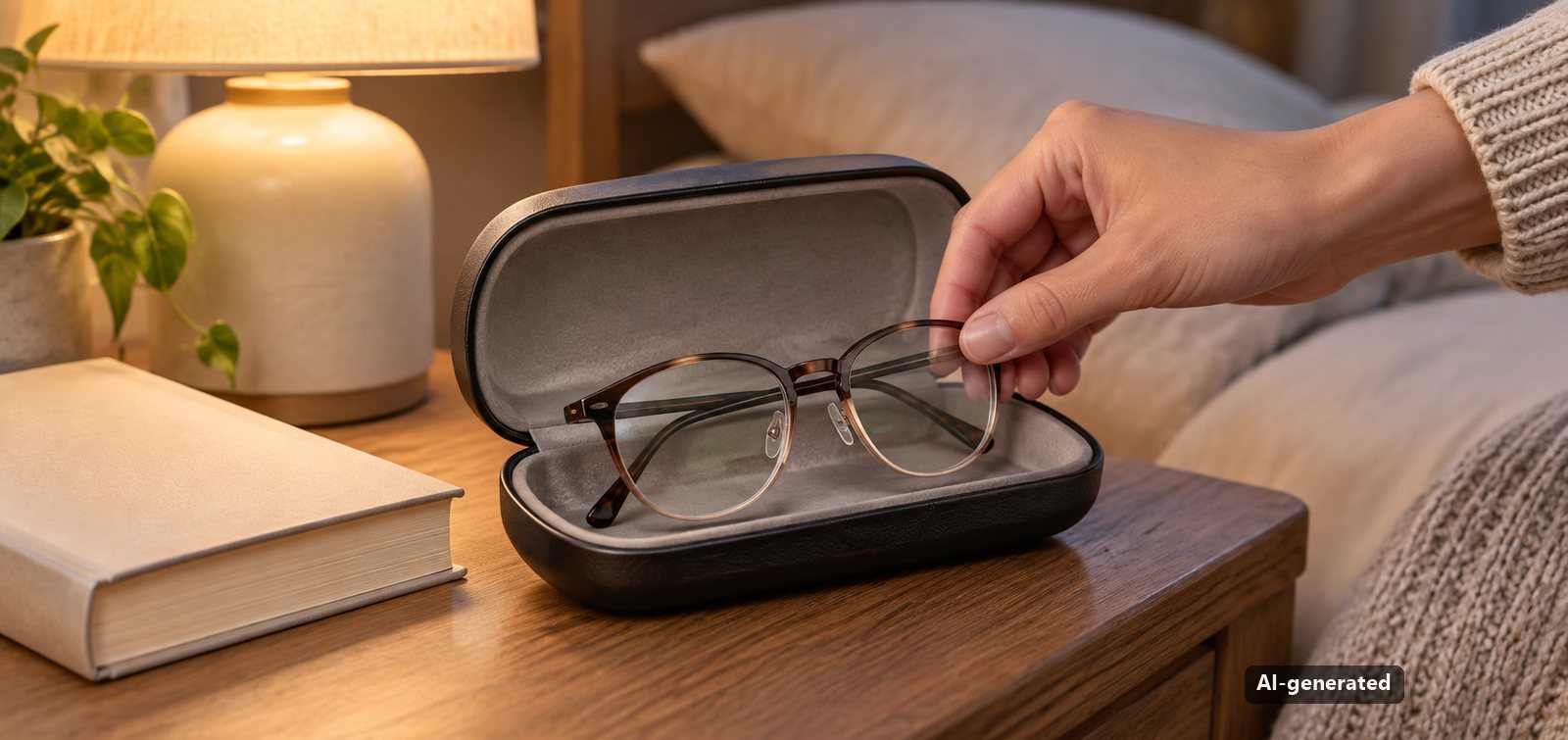
In their case on your bedside table. ZEISS says that when you won’t be wearing your glasses for a while, for example overnight, a suitable case is the best place for them. That way they’re within reach in the morning, can’t slide off the edge and won’t end up under a book or your phone.
Without a case, the same rule applies: folded, resting on the arms, away from the edge of the table. Put them in the same spot every night so you’re not feeling around for them in the morning.
If you have a dog, the case matters even more. According to ZEISS, dogs love to chew on arms and lenses.
How do you protect glasses when travelling, at the gym and with children?
With a hard case and a fixed place for it. On the move, glasses get squashed, knocked about or end up in sand and sun. A sturdy case in its own compartment of your suitcase, gym bag or school bag takes care of that, and children also benefit from a clear routine.
Travelling
Pack your glasses in a hard case in your hand luggage, so they’re within reach and don’t get crushed in your suitcase. On the beach, keep them in the case rather than on your towel: ZEISS warns that wiping lenses with a towel or T-shirt there can scratch them through fine sand, even the first time. If you can barely see without your glasses, bring a spare pair.
At the gym
While you train, your everyday glasses belong in a hard case in your bag, not loose between trainers and water bottle. If you head to the sauna afterwards, leave them in your locker, as ZEISS and Rodenstock both advise against taking glasses into the sauna. If you need your prescription during the sport itself, a sports strap keeps your glasses in place.
Children
Children’s glasses need a sturdy case and a fixed home: always the same spot in the house, always the same pocket in the school bag. Show your child how to take their glasses off with both hands and put them into the case folded. For younger children, a glasses strap stops them being left lying around.
How should you store a spare pair of glasses?
In a hard case, somewhere dry and at normal room temperature, so a drawer rather than the glovebox. Rodenstock says lenses are designed for normal temperature and humidity, not extreme heat. Add a clean cloth, and check now and then that your spare pair still sits straight and that the prescription still suits you.
Your second pair could also be prescription sunglasses that wait in their case in your bag until the sun comes out. If you prefer a light frame for everyday wear, take a look at titanium glasses.
 Miu Miu MU B07S 16K04O£203.62Oakley WINGFOLD EVR (OX5118 511803)£100.54Prada PR 65ZS ZVN09T£150.21Oakley WINGFOLD EVR (OX5118 511801)£102.64Ray-Ban BILL (RB2198 129251)£95.70Oakley WINGFOLD EVR (OX5118 511804)£98.45
Prices include VAT. Free standard delivery within the UK. Express delivery and other countries: shipping costs.
View all glasses →Glasses storage: frequently asked questions
Can I leave my glasses in the car in winter?
Ideally not overnight. According to ZEISS, glasses can warp in severe cold. So take them with you whenever you park, whatever the season.
Can heat damage be repaired?
Usually not on the lens itself: ZEISS says damage such as scratches can’t be polished out of plastic lenses, and the lens can’t be given a new finish. Minor problems with the frame, on the other hand, can usually be fixed quickly, according to ZEISS. An optician can tell you which applies to your glasses.
How should I store several pairs of glasses?
Ideally each pair in its own case, or in a box with separate compartments so the lenses don’t touch. Keep them somewhere dry and out of direct sunlight. If your reading, screen and sunglasses look alike, label the cases.
Before your glasses go back in the case, give the lenses a proper clean: our guide How to clean glasses shows you how to do it without scratching them.