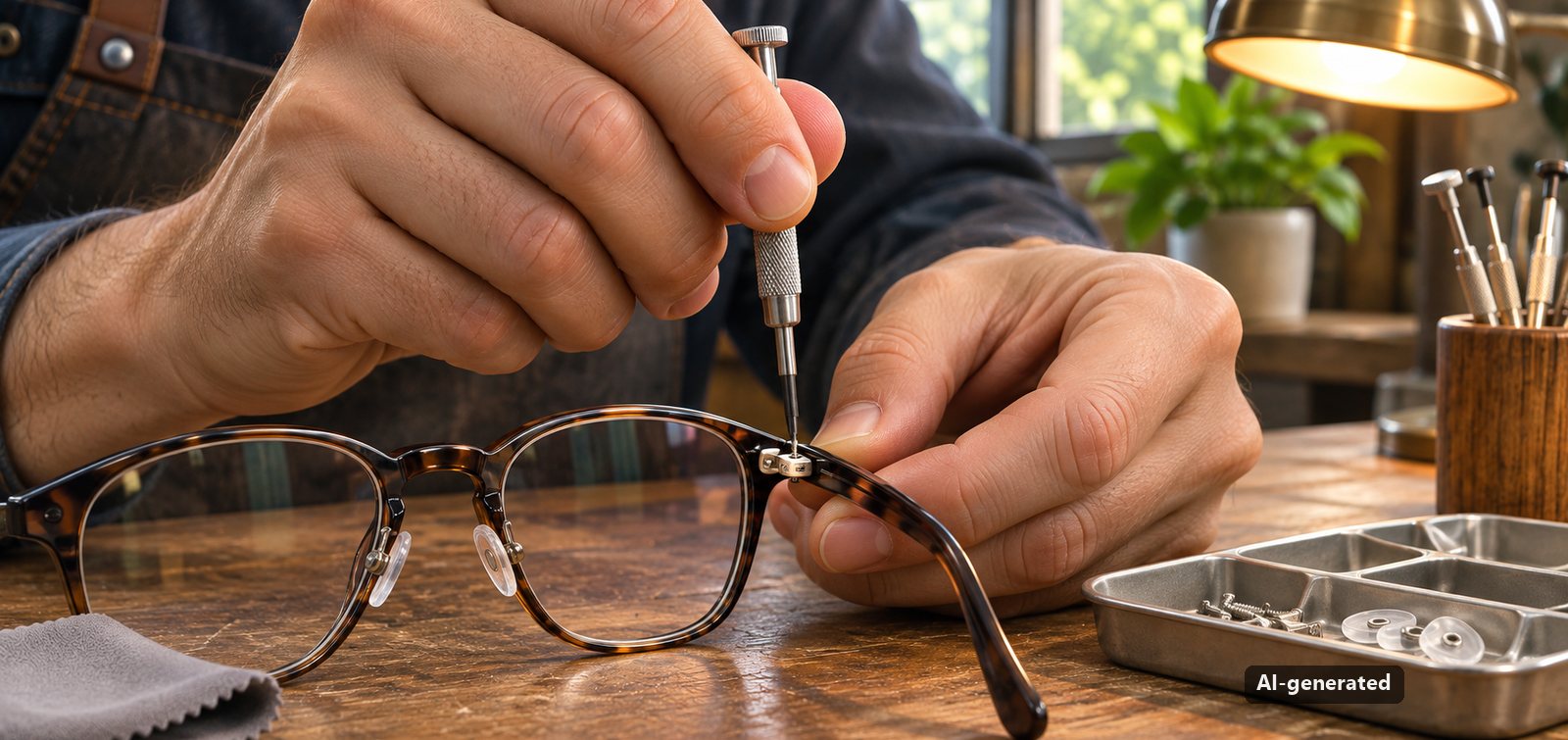
Your glasses keep slipping down your nose, you push them back up all day, and by evening they dig in behind your ears. Glasses slipping down your nose almost always come down to one of five causes, and most can be fixed in a few minutes. The table below helps you find yours and shows what you can safely do yourself.
In short
- Usually the arm tips are too straight, the nose pads are set wrong, the frame is too wide or your skin is oily.
- An optician can bend the arms, adjust the pads and tighten the screws, often in just a few minutes.
- Never bend acetate with a hairdryer or hot water, and never force a metal frame.
- If the bridge simply doesn’t suit your nose, the lasting fix is a different frame with adjustable nose pads.
Why do glasses keep slipping down your nose?
Glasses rest on three points, your nose and the back of each ear, and they slip as soon as one of them stops gripping. Usually the arm tips are too straight or stretched, the frame is too wide, or the bridge doesn’t sit properly. Oily skin, sweat and heavy lenses make every one of these worse.
- Arms: The tips don’t hug the back of your ear, or the hinges have worked loose. Nothing holds the frame from behind.
- Frame width: If the frame is wider than your head, the arms stand away from it and can’t grip.
- Bridge: Too wide and the glasses sink lower, too narrow and it pinches the sides of your nose. On a low nose bridge, a fixed bridge often finds no grip at all.
- Material and weight: Acetate gives a little over time with body heat. Thick lenses and heavy frames pull everything forwards.
The symptom usually tells you which cause applies to you.
Which symptom points to which cause?
If your glasses slide forwards, the arms usually lack grip. If they pinch, they are too tight in one spot, and if they sit crooked, an arm is usually bent. The table lists the seven most common symptoms with the cause and the fix, whether that’s a job for an optician or for you.
| Symptom | Likely cause | Fix |
|---|---|---|
| Keep slipping forwards | Arm tips too straight, loose hinges, frame too wide | Have the tips re-bent and the screws tightened |
| Pinching on the nose | Bridge too narrow, pads set wrong or hardened, frame too heavy | Have the pads widened or replaced, choose a lighter frame |
| Hurting behind the ears | Arm tips bent too tightly or arms too short | Have the curve opened up, choose longer arms |
| Pressing on the temples | Frame too narrow for your head | Have the arms eased outwards, otherwise a wider frame |
| Sitting crooked | Bent arm, ears at different heights | Have the arm angle adjusted by an optician |
| Slipping only during sport or in the heat | Sweat and movement | Silicone pads, ear hooks or a sports strap |
| New glasses slipping | Not yet fitted to your head | Get them adjusted by an optician |
Almost every fix in the table needs special pliers and a bit of practice. How much you can do yourself depends on the material.
How do you stop glasses slipping yourself?
You can safely do anything that doesn’t involve bending: clean the frame, degrease the nose pads, carefully tighten loose screws and add aids such as silicone pads or ear hooks. Leave bending the arms or bridge to an optician. One wrong move can warp the frame or snap it.
Safe to do at home
- Clean the contact points: Wash the nose pads and arm tips in lukewarm water with a drop of washing-up liquid. Without the film of oil, they grip better.
- Check the screws: If an arm wobbles, tighten the hinge screw with a small glasses screwdriver. Don’t overtighten it.
- Use simple aids: Stick-on silicone pads, arm sleeves or a sports strap, more on these below.
Best avoided
- Bending acetate with a hairdryer or hot water: The plastic heats unevenly and can warp or crack. The heat can also damage the lenses.
- Forcing a metal frame: Without the right pliers, arms kink, soldered joints break and pad arms snap off.
- Home remedies such as tape or hairspray: They help briefly but leave residue on the frame and lenses.
Still slipping after that? An optician is the quickest fix.
What can an optician fix in a few minutes?
An optician bends the arm tips to follow the curve behind your ear, sets the nose pads closer together or further apart and tightens loose hinge screws. Acetate frames are first warmed evenly with a frame heater, and hardened pads are swapped for new ones. Most of this is done while you wait.
- Check the fit: The optician looks at where the glasses rest and where they press.
- Adjust the arms: The tips are bent to follow the curve behind your ear.
- Set the pads: On metal frames, the pad arms are moved closer, wider, higher or lower.
- Replace small parts: Loose screws are secured and worn pads replaced.
Many opticians will also adjust a frame you bought elsewhere. Ask beforehand whether there’s a charge.
How do you make glasses tighter on your nose?
On metal and titanium frames, an optician moves the pad arms closer together, so the glasses sit higher and more firmly. Acetate frames usually have a fixed bridge, so stick-on silicone pads inside the bridge are the answer. If the frame rests on your cheeks, adjustable pads or a different bridge shape will help.
- Adjustable nose pads: They sit on small metal arms and can be set for low and high nose bridges alike.
- Silicone instead of hard plastic: Soft silicone pads grip better and spread the pressure over a larger area.
- Stick-on pads for acetate frames: They cushion the inside of the bridge and lift the glasses slightly.
Which bridge suits which nose → High bridge glasses
How do you stop glasses slipping during sport or when you sweat?
Sport combines sweat with constant movement, and a normal fitting often can’t cope. Silicone pads grip even on damp skin, ear hooks hold the arms behind your ears, and a sports strap links both arm tips at the back of your head. If you run or cycle regularly, a close-fitting pair of sports glasses is the better choice.
- Arm sleeves and ear hooks: They slide over the arm tips and wrap around the ear. Handy for running.
- Sports strap: An elastic band keeps the glasses in place even during quick head movements.
- Before training: Wipe the bridge of your nose and the pads with a dry cloth.
How do you choose glasses that stay put?
Glasses sit securely when the width suits your head and the bridge rests on your nose. The arms also need to be long enough to curve behind your ears. You’ll find the measurements on the inside of the arm, for example 52□18-140, and can compare them with a pair that already fits well.
- Lens and bridge width: The first two numbers, here 52 and 18 millimetres. A bridge that’s too wide lets the glasses sink, one that’s too narrow pinches.
- Arm length: The last number, usually between 135 and 150 millimetres. Arms that are too short dig in behind the ear, ones that are too long don’t hold.
- Weight: For the same volume, titanium weighs around 40 per cent less than stainless steel. The lighter the frame, the less it pulls forwards.
- Nose pads: Metal and titanium frames usually have adjustable pads that can be set to suit almost any nose.
Rule of thumb: If every acetate frame slides down your nose, try a lightweight metal or titanium frame with adjustable pads.
 Oakley WINGFOLD EVR (OX5118 511803)£100.54Ray-Ban RX3928V 2500£80.51Oakley WINGFOLD EVR (OX5118 511801)£102.64Ray-Ban RX3928V 2501£82.19Oakley WINGFOLD EVR (OX5118 511804)£98.45Ray-Ban RX3768V 2500£66.82
Prices include VAT. Free standard delivery within the UK. Express delivery and other countries: shipping costs.
All titanium glasses →Frequently asked questions about glasses that slip
Why are my new glasses slipping?
New glasses arrive with a standard setting that isn’t yet shaped to your head. The arm tips are often too straight. A quick visit to an optician usually sorts this out on the spot.
Why do my glasses hurt behind my ears?
The arm tips are usually bent too tightly, or the arms are too short. An optician can open up the curve a little. If the arms are simply too short, a frame with longer arms is the better fix.
Do plastic frames slip more easily than metal ones?
Not as a rule. But acetate frames usually have a fixed bridge without adjustable pads, so their fit on the nose can hardly be changed. On metal and titanium frames, an optician can set the pads precisely.
What if my glasses still pinch after adjustment?
Then the frame probably doesn’t suit the shape of your head or nose. If pressure marks persist, have the fit checked by an optician. A different bridge width or arm length often solves it.
If your glasses still slip after adjusting, take a look at the lightweight titanium and metal frames with adjustable nose pads above.