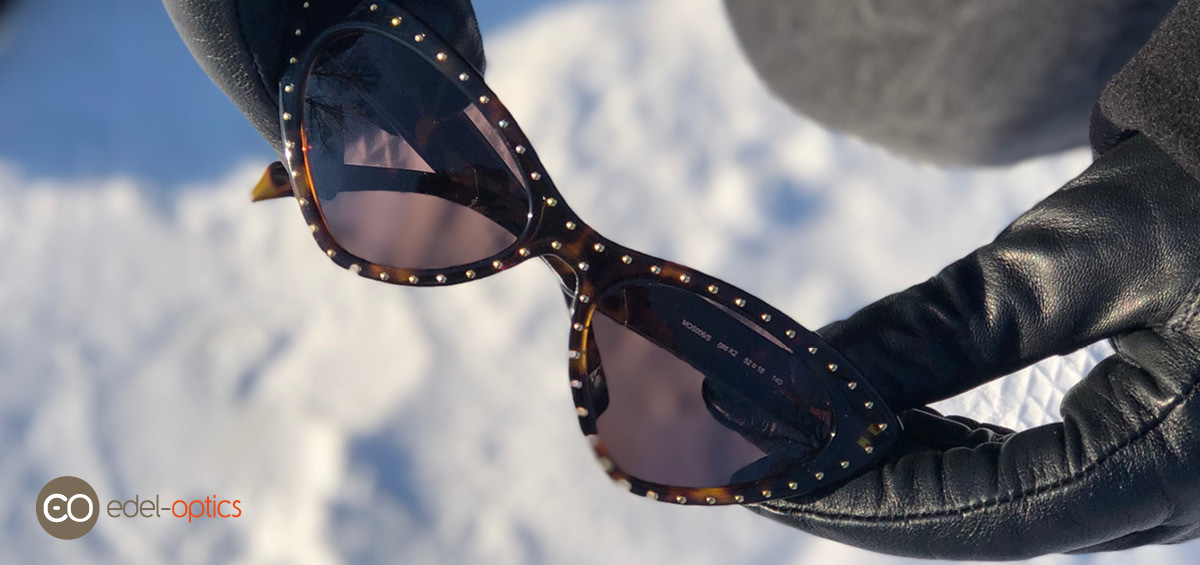
Looking for the best sunglasses for skiing? Ski sunglasses are lighter and better ventilated than ski goggles, which makes them a great choice on sunny days, for cross-country skiing and for ski touring. Here you will find out what matters when it comes to lens category, UV protection, lens colour and fit, plus proven models for men and women.
Key points at a glance
- Sunglasses suit sunny days, spring snow, cross-country skiing and ski touring. In snowfall, wind, cold and on fast descents, goggles are usually the better choice.
- Look for UV400 and the CE or UKCA mark: snow reflects a large share of UV radiation.
- Category 3 lenses suit most days on the slopes, category 4 is for glaciers. Category 4 is not suitable for driving.
- In flat light, bright lens colours such as yellow, orange or rose work well. Polarised lenses reduce glare but can make icy patches harder to spot.
Ski sunglasses or goggles: which is better for skiing?
Ski goggles seal around your eyes with a foam frame and are worn with a strap over your helmet. Ski sunglasses are sports sunglasses with temples and usually strongly curved wraparound lenses. Both have their strengths:
| Ski sunglasses | Ski goggles | |
|---|---|---|
| Weight | light, fit in your jacket pocket | bigger and heavier |
| Ventilation | airy, fog up less when you work hard | closed, more likely to fog on climbs |
| Wind, snow, cold | depends on shape and side coverage | fully sealed |
| Fit at speed and in falls | sit securely but can slip | held firmly by the helmet |
| Typical use | sunshine, spring skiing, cross-country, ski touring, après-ski | snowfall, cold, freeride, snow park, fast descents |
That is why many skiers and snowboarders take both: goggles for cold, windy days and sunglasses for sunshine, lunch breaks and the lift queue. Everything about goggles is in our guide on how to choose ski goggles.
Best sunglasses for cross-country skiing and ski touring
When you are cross-country skiing or skinning uphill, you move more slowly and sweat more. Goggles fog up quickly, while well-ventilated sunglasses tend to stay clear. Ski instructors and spring skiers on slushy snow often prefer sunglasses for the same reason.
What to look for in sunglasses for skiing
UV protection: UV400 and CE, because snow reflects strongly
In the mountains, UV radiation hits you from above and bounces back off the snow. According to the World Health Organization (WHO), fresh snow reflects up to 80 per cent of UV radiation, and UV levels rise by around 10 per cent for every 1,000 metres of altitude. So look for UV400 and the CE or UKCA mark: UV400 means the lenses filter UV radiation up to 400 nanometres, and the mark shows that the sunglasses meet the requirements for sunglasses in Europe and the UK.
Without adequate UV protection, intense radiation on snow can cause a painful inflammation of the cornea and conjunctiva known as snow blindness. If your eyes are sore after a day in the snow, see an optometrist or doctor. By the way, the lens tint says nothing about UV protection: even light lenses can be UV400.
Lens category: category 3 for the slopes, category 4 for glaciers
The filter category from 0 to 4 tells you how much visible light gets through the lens. It is usually printed on the inside of the temple.
| Category | Light transmission | Best for |
|---|---|---|
| 2 | 18–43% | cloudy days, changing light |
| 3 | 8–18% | sunny days on the slopes, the usual standard for snow sports |
| 4 | 3–8% | glaciers, high mountains, bright spring snow |
Category 4 lenses are so dark that they are not suitable for driving, so you will need a second, lighter pair for the drive to the resort. Classic glacier glasses combine category 4 lenses with side shields so that hardly any light gets in from the side.
Lens colour: the right tint for sun, cloud and flat light
| Light | Lens colour | Category |
|---|---|---|
| Bright sun, glacier | grey, dark brown, often mirrored | 3 or 4 |
| Sun and cloud | brown, copper, rose, red | 2 or 3 |
| Flat light, fog, snowfall | yellow, orange, amber, light rose | 1 or 2 |
In flat light, the diffuse light under thick cloud or in fog, shadows disappear and bumps and edges are hard to see. Bright, contrast-enhancing lenses can make contours stand out more clearly, while grey lenses are usually too dark on these days. For changeable weather there are photochromic lenses that adjust their tint to the light, and models with interchangeable lenses.
Good to know: Oakley has developed its own Prizm Snow tints, mainly for goggles, ranging from Prizm Snow Black Iridium for bright sun to Prizm Snow Persimmon for cloud and flat light.

Polarised lenses on snow: pros and cons
Polarised lenses reduce glare from reflections on smooth surfaces, including hard, shiny snow. That is welcome on sunny days, for cross-country skiing and on the terrace. The downside: icy patches shine less and are therefore harder to spot. Phone and GPS screens can also look dark.
If you ski a lot on hard, icy pistes, a good non-polarised lens is often the better choice. Polarised sunglasses for snow glare are most useful on sunny days away from fast descents. Find out how polarisation works in our article on polarised lenses.
Side coverage, ventilation and fit with a helmet
- Side coverage: a strongly curved frame or a large shield lens keeps out light and draughts from the side.
- Ventilation against fogging: some space between lens and face, vents or a frame that is open at the bottom let air circulate. An anti-fog coating also helps.
- Fit with a helmet: thin, straight temples fit better under the helmet padding. Try the sunglasses on with your helmet: they should not press and should not leave a big gap at the top.
- Secure fit and shatter-resistant lenses: non-slip nose pads and temple tips keep the frame in place even when you sweat. Polycarbonate lenses are more shatter-resistant than glass.
Ski sunglasses for men and women: size matters most
Most sports sunglasses are unisex. Whether men’s skiing sunglasses or the best sunglasses for skiing for women suit you depends mainly on size: they should reach your eyebrows, sit close to your face at the sides and not slide down your nose. Many models come in several sizes, such as the Holbrook XL for wider faces or the Sutro Lite S for narrower faces. Tip: compare the measurements on the inside of the temple of a pair that fits you well with the details in our shop.
The best sunglasses for skiing: proven models
We have not tested the following models ourselves. They are a selection from our current range, sorted by use. You can see which colours and lenses are available for each model in our shop.
Oakley Radar EV Path: for the slopes, cross-country and touring

If you are looking for the best Oakley sunglasses for skiing, the Radar EV Path is a good place to start: it is one of the brand’s best-known sports models. The large lens, extended at the top, gives you a wide field of view, and the Unobtainium nose pads and earsocks stay put even when you sweat.
Oakley Sutro, Sutro Lite and Sutro Lite Sweep: plenty of coverage
The one-piece shield lens covers a large part of your face and shields well at the sides. The Sutro Lite is lighter and open at the bottom, the Sutro Lite Sweep is rimless, and the Sutro Lite S is made for narrower faces.
Oakley Flak 2.0 XL: the sporty all-rounder
This lightweight half-rim sports frame has a large, curved lens that is taller in the XL version than on the standard Flak 2.0. The open lower edge lets air reach the lens.
Oakley EyeJacket Redux and SI Ballistic M Frame 3.0: wraparound and robust
The EyeJacket Redux revives a classic Oakley design and wraps well around your face. The Ballistic M Frame 3.0 from the SI (Standard Issue) range for armed forces and emergency services has a large shield lens designed for high impact resistance.
Oakley Holbrook, HSTN and Frogskins: for the terrace and après-ski
For lunch on the terrace, a winter walk or the journey to the resort, lifestyle models are all you need. They are flatter and offer less side coverage, but also work in town. They are less suited to fast descents.
 Oakley EYEJACKET REDUX (OO9438 943805)£118.15 P
 Oakley RADAR EV PATH (OO9208 920847)£115.67
 Oakley HOLBROOK (OO9102 9102D6)£125.37 P
 Oakley EYEJACKET REDUX (OO9438 943801)£92.23
 Oakley HSTN (OO9242 924207)£105.61
 Oakley TERRAFORMA (OO9530 953001)£75.94
 Oakley TERRAFORMA (OO9530 953006)£120.25 P
 Oakley RADAR EV PATH (OO9208 920846)£113.98
Prescription ski sunglasses: tips for glasses wearers
- Prescription sunglasses: many sunglasses can be fitted with lenses in your prescription. With strongly curved sports frames, however, the range of possible prescriptions is limited.
- Contact lenses: with contacts you can wear any non-prescription ski sunglasses.
- Goggles over your glasses: OTG goggles (over the glasses) fit over your normal glasses.
Read more in our guide to prescription lenses for sunglasses. Your optician or optometrist can tell you which lenses you need.
FAQ about ski sunglasses
What are the best ski sunglasses? Is there an overall winner?
We have not tested the models in this guide ourselves, so we do not name a winner. The best ski sunglasses are the ones that suit your conditions and your face. Compare UV400 and CE or UKCA, lens category, lens colour, polarisation, side coverage, ventilation, fit with a helmet and weight. When reading reviews, check when and by which criteria the sunglasses were tested.
What are the best sunglasses for snow and glaciers?
Category 3 is usually enough for a normal day on the slopes. On glaciers and at high altitude, category 4 lenses with side shields make sense, but they are not suitable for driving.
Are good sunglasses for skiing also good for snowboarding?
Yes. What matters for snowboarding is the same: UV400, the right lens category and a secure fit. In the snow park or on powder days with lots of falls, many snowboarders prefer goggles.
Sunglasses or goggles for children?
For children, goggles are usually the better choice. They sit firmly on the helmet and seal all round against snow and wind. Here too, look for UV400 and the CE or UKCA mark.