Oversized glasses are large glasses with big lenses and often a bold frame. They suit women and men alike, as prescription glasses or as sunglasses. Here you will find out where this retro trend comes from, which shapes suit which faces and what to consider when it comes to size, weight and prescription lenses.
Key points at a glance
- Oversized means large, often tall lenses and a strong front. The look comes from the 1960s to 1980s and has come back again and again ever since.
- Large glasses suit medium to wide faces best. On a round face, angular oversized frames work better than round ones.
- Oversized is not the same as a larger size: if you have a big head, a wide front and long temples matter most.
- With a prescription, large lenses become thicker and heavier: at the edge for minus lenses, in the centre for plus lenses. High-index lenses keep this in check.
What are oversized glasses?
Oversized glasses have large lenses that are deliberately big in relation to the face. Typical features are tall, wide lenses and a strong front that often reaches from the eyebrows down to the cheekbones. You will also see them called large glasses, big glasses or XXL frames.
To give you an idea: many prescription frames have lens widths of around 48 to 54 millimetres. Oversized frames are often wider and, above all, have much taller lenses; for sunglasses, 60 millimetres or more is not unusual.
Oversized glasses frames do not have to be chunky: there are thick acetate frames as well as delicate metal frames with large lenses.
A retro trend with history: oversized vintage glasses
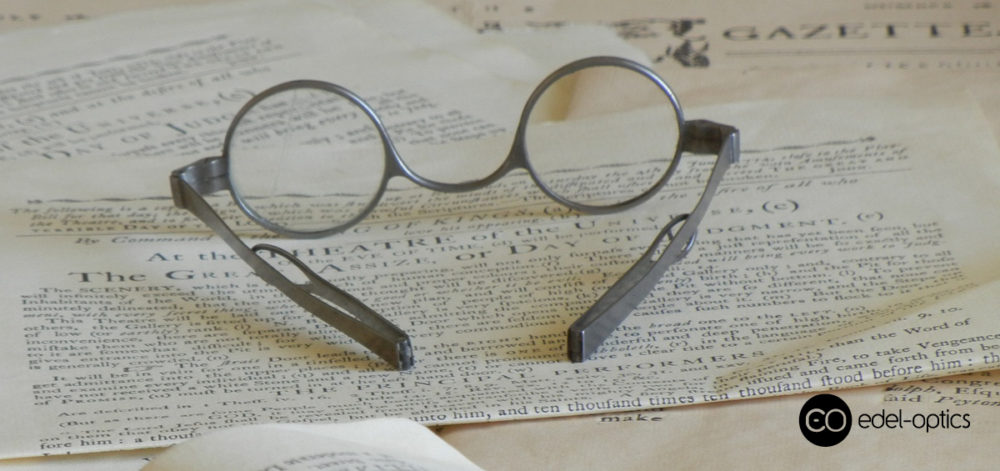
Large glasses are nothing new. In the 1960s, film stars and style icons made oversized sunglasses popular. Round or square styles with very large lenses are still often called “Jackie O” sunglasses, after Jacqueline Kennedy Onassis.
In the 1970s, prescription glasses got bigger too: tall lenses, often with low-set temples, in plastic or as large metal aviators. The 1980s brought wide, angular frames and bold colours. Since then, the look has kept coming back.
Are big glasses in style?
Retro oversized glasses are less a short-lived large glasses trend than a style that designers keep reinventing. What changes is mainly the shape: sometimes square frames are in demand, sometimes round or cat-eye styles. If a large pair suits you and fits well, it will not look dated.
Oversized glasses for women: shapes and who they suit
Oversized glasses for women come in almost every shape:
- Butterfly: lenses that widen towards the top outer corners, especially common in sunglasses
- Cat-eye: upswept outer corners that visually lift the face
- Square and rectangular: strong lines for soft features
- Round and oval: a soft retro look, especially with a thin metal frame
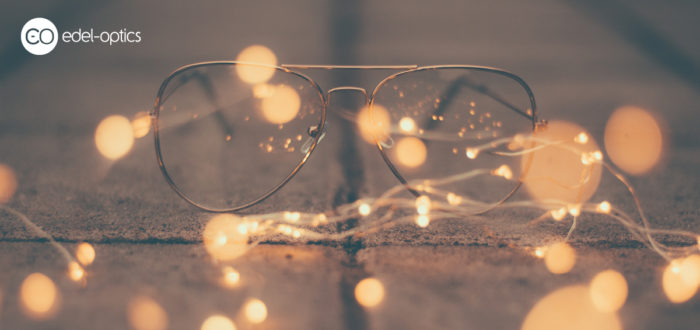
- Aviator: teardrop-shaped lenses, a classic in large sunglasses
Oversized glasses for round and heart-shaped faces
Large glasses suit medium to wide faces best, where small frames tend to get lost. Wondering what shape of glasses suits a round face? Even on a big round face, angular oversized frames create contrast, while round XXL glasses emphasise the curves and work better on an angular face. For a heart-shaped face, choose shapes that are not too heavy at the top, such as aviators. A narrow face carries large lenses best with a fine frame or a transparent colour. More in our guide What glasses suit my face?
Oversized glasses and eyebrows
With oversized glasses, your eyebrows often disappear partly or completely behind the top of the frame. With prescription glasses, the look is usually calmer if the top edge roughly follows the line of your brows and they are just visible above it. With sunglasses, covering the brows is often part of the look.
Large glasses for men: oversized style or a bigger size?
Men usually look for large glasses for one of two reasons: for the oversized look, or because they need a bigger size as standard frames are too narrow.
Oversized as a style: big glasses for men
On men, large glasses work best with clean lines: square acetate frames, panto glasses with tall lenses, browline frames with a pronounced top rim and large metal aviators. Black, tortoiseshell and dark metal tones stay understated, while transparent or coloured frames make a statement. With a full beard, the glasses can be bolder too.
Bigger frames for men with big heads
If the temples press against the side of your head or your face sticks out beyond the frame, you do not need oversized glasses but a bigger size. What matters then is the total width of the front and the temple length, not the size of the lenses: even oversized glasses can have a narrow front and short temples. Larger frames are also available for women, often as unisex styles. Which measurements matter for a big head is covered in our article Glasses for big heads.
Size, fit and weight: how large glasses should fit
Even deliberately large glasses need to fit well. The measurements are usually printed inside the temple, for example “56□18 145”: lens width, bridge width and temple length in millimetres. Compare them with a pair that fits you well. This is how you can tell whether the size is right:
| Feature | Good fit | Too big |
|---|---|---|
| Width | front about as wide as your face at the temples, or slightly wider | front sticks out clearly at the sides |
| Cheeks | lower rim stays clear, even when you smile | rim rests on your cheeks and lifts the glasses when you smile |
| Nose | bridge sits without a gap, the glasses stay up | glasses keep slipping down |
| Temples | sit without pressure and reach behind the ears | leave a lot of space at the sides, the glasses wobble |
Weight: what matters with large glasses
Thick acetate frames weigh more than metal or titanium frames, and large lenses weigh more than small ones. Frames in titanium or thin metal and plastic lenses instead of mineral glass keep large glasses lighter. Nose pads or a well-fitting bridge spread the weight, and well-adjusted temples hold the glasses behind the ears. An optician can adjust the temples for you.
Vintage oversized prescription glasses: lenses, thickness and weight
Oversized frames can be fitted with your prescription like any other optical frame. Because the lenses are larger, more of their properties show:
- Short-sightedness (minus values): the lens is thickest at the edge, and the wider the lens, the thicker the edge. If your pupil sits closer to the nose than to the centre of the lens, the outer edge gets a little thicker still.
- Long-sightedness (plus values): the lens is thickest in the centre. Large plus lenses therefore become thicker and heavier.
- How your eyes look: minus lenses make your eyes look smaller and plus lenses make them look bigger; with large lenses, this shows over a bigger area. Make-up that emphasises your eyes balances this a little.
- Varifocals: large frames offer enough height for all viewing zones. With very wide lenses, the less sharp side zones sit more in your field of view. Ask your optician for advice.
High-index lenses, for example 1.6 or 1.67, are thinner and lighter for the same prescription. Thick acetate frames also hide thick lens edges better than thin metal frames. Your optician can tell you which index makes sense for your prescription.
Oversized sunglasses for women: what to look for
Sunglasses are where large lenses really pay off: they cover more of the eye area and let in less light from the side. When buying, look out for:
- UV protection: good sunglasses are marked UV400 and carry the CE mark.
- Lens colour: grey changes colours the least, brown looks more contrasting. Gradient lenses are darker at the top than at the bottom.
- Polarisation: polarised lenses reduce glare from reflections, for example on water or wet roads.
- Prescription: flat fronts are easier to fit with prescription lenses than strongly curved styles. Our guide to prescription lenses for sunglasses explains what to consider.
In the shop you will find women’s sunglasses in many shapes and sizes, including Prada, Miu Miu, Gucci and Ray-Ban. One large classic for women and men, currently available, is the Ray-Ban Aviator Large Metal. Before you buy, compare the lens width with a pair of sunglasses that fits you well.
 Miu Miu MU A51S 5AK20P£247.93
 Miu Miu MU B07S 16K04O£200.63
 Prada PR 65ZS ZVN09T£150.47
 Ray-Ban BILL (RB2198 129251)£95.87
 Prada PR B15S 17N70R£193.94
 Ray-Ban CATS 5000 (RB4125 710/51)£95.87
 Prada PR 15WS 01R0A6£144.40
 Oakley RADAR EV PATH (OO9208 920847)£113.98
Oversized glasses: frequently asked questions
How can I tell if my glasses are too big?
Typical signs: the glasses keep slipping down, the lower rim rests on your cheeks or the front sticks out clearly at the sides. An optician can often improve the fit by adjusting the temples. If the front is too wide, only a smaller size will help.
Do oversized glasses suit a small face?
Yes, if the proportions are right: large lenses with a fine frame, a light or transparent colour and a front that does not stick out clearly beyond your face. Very chunky acetate frames, on the other hand, quickly look heavy.